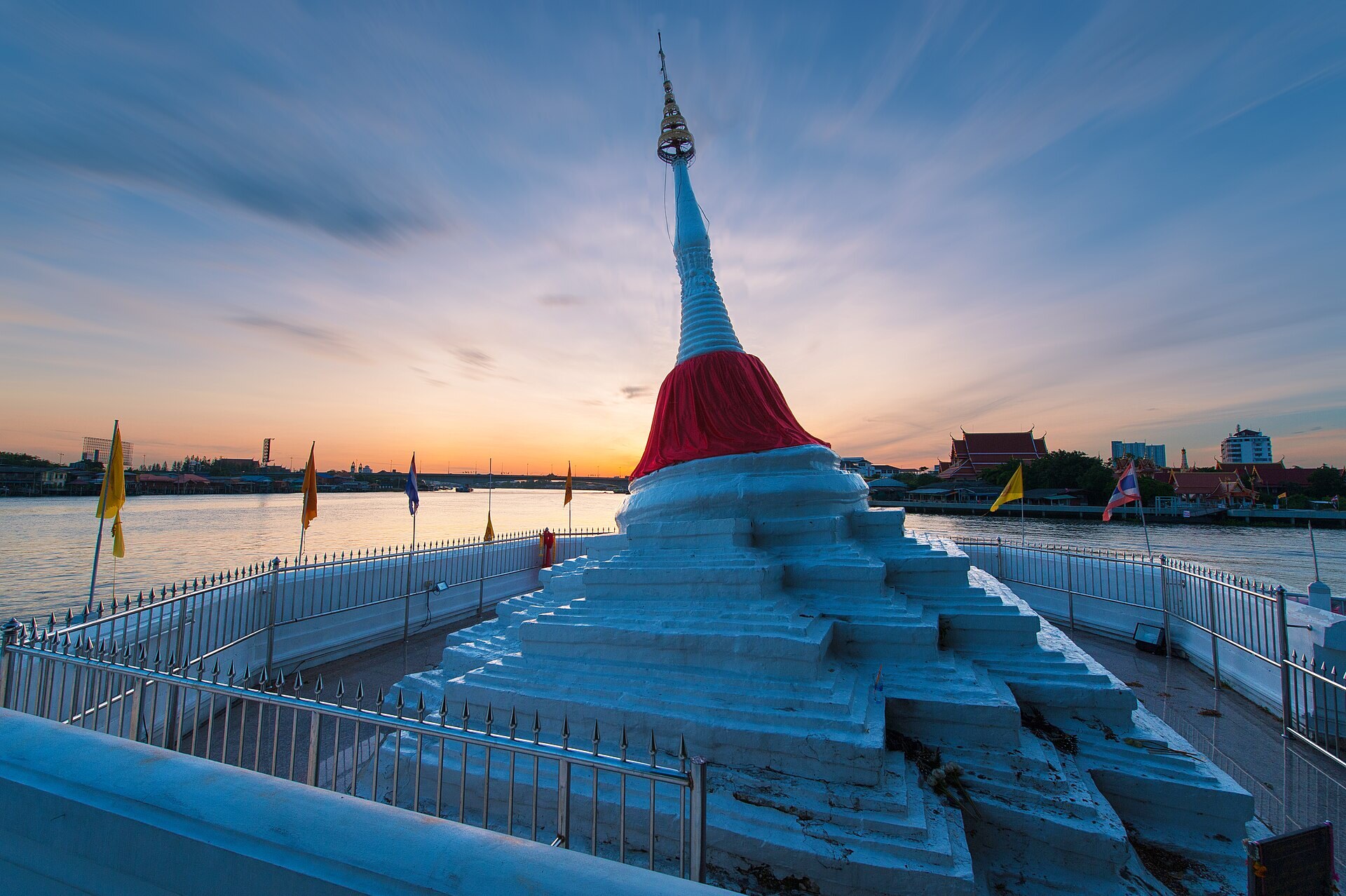
Wat Poramaiyikawat sits a short walk from the main pier on the northern tip of Koh Kret, and most visitors reach it within ten minutes of stepping off the ferry. It is the island's principal temple, founded in the early 1700s when Mon refugee communities settled this stretch of the Chao Phraya, and it remains the easiest place to understand why the island's identity is Mon rather than generically Thai. The temple compound is free to enter, open roughly from early morning until early evening (check the day's schedule at the entrance, as hours shift slightly around festival dates), and it asks nothing more than shoulders and knees covered and shoes off before entering the main hall.
The leaning chedi
The structure everyone comes to see is the white chedi near the river's edge, which has subsided and tilted for years as the bank beneath it erodes. It is not dangerous to walk near, and a low rail keeps visitors at a sensible distance rather than blocking the view. The lean is gradual enough that photographs from a decade apart show real movement, and it has become a quiet symbol of the island itself: something old, slightly unsteady, still standing. There is no official viewing platform, so the best angle is simply from the riverside path a few metres back, ideally in the soft light of early morning before the heat sets in.
The ubosot and its Mon details
Inside the main ordination hall (ubosot), the Buddha image and the roof details reflect a Mon style distinct from central Thai temple convention, a point worth noticing rather than skimming past. Door and window frames carry stucco work rebuilt after a serious flood over a century ago, and some interior murals are faded enough that a guide or a signboard reading is more useful than relying on your own eye. Visitors should move quietly if a monk or a small group is chanting, which happens most mornings and on Buddhist holy days (wan phra), and photography of the main Buddha image is generally tolerated without flash.
Timing your visit around the ferry and the market
Because the temple sits so close to the pier, most people fold it into the start or end of a loop that also covers the pottery kilns and the weekend market. If you are arriving via the route described in Getting to Ko Kret: Grab, Bus 166 and the Express Boat, the temple makes sense as your first stop, since it orients you before the lanes get busy. On Saturdays and Sundays the approach path can be dense with stalls and foot traffic by mid-morning; arriving before 9:00 gives a calmer look at the chedi and the hall before the crowds thicken, a pattern covered in more detail in Koh Kret Weekend Market: Lanes, Stalls and the Eating Order.
No entrance fee is charged. Small donation boxes are placed near the main hall and the chedi; 20 to 50 baht is a common and welcome amount. Sarongs are sometimes available to borrow at the entrance for visitors in shorts, but bringing a light scarf or long trousers avoids any delay.
Reading the temple against the island's history
Wat Poramaiyikawat only fully makes sense alongside the story of why Mon communities settled here at all, fleeing conflict in Burma and resettling along this Chao Phraya bend under royal permission. The temple was their anchor point, and much of what looks decorative today (the stucco patterns, the proportions of the hall) traces back to building traditions carried across the border generations ago. For the fuller account, The Mon of Koh Kret: A Short History of the Pottery Island lays out the resettlement timeline and why the island became a pottery centre rather than a farming one. Visiting the temple with that context changes it from a pretty stop into a legible piece of local history.
What to pair it with on the same visit
Because the temple takes most people only twenty to thirty minutes to see properly, it rarely stands alone as a reason for the trip. The usual pattern is temple first, then the kiln lanes for Kwan Aman: The Mon Pottery of Koh Kret, From Wheel to Kiln, followed by something to eat, whether that is the crab noodles or a bowl of khao chae described in Eating Ko Kret: Mon Dishes, Crab Noodles, Khao Chae. Those with more time sometimes extend the morning into the full island circuit outlined in Koh Kret bike loop: seven quiet kilometres, what to see, which passes the temple again from a different angle near its midpoint.
Weekday versus weekend at the temple
On weekdays the compound is close to empty outside of a handful of local worshippers, and the chedi photographs cleanly without people crossing the frame. On weekends, particularly Sunday afternoons in the cool season (roughly November to February), tour groups arriving by chartered boat can fill the forecourt for twenty-minute windows before moving on. Neither timing is wrong, but if quiet is the priority, a weekday morning visit paired with the broader seasonal planning in When to Visit Koh Kret: A Season-by-Season Weekend Guide will serve you better than guessing.