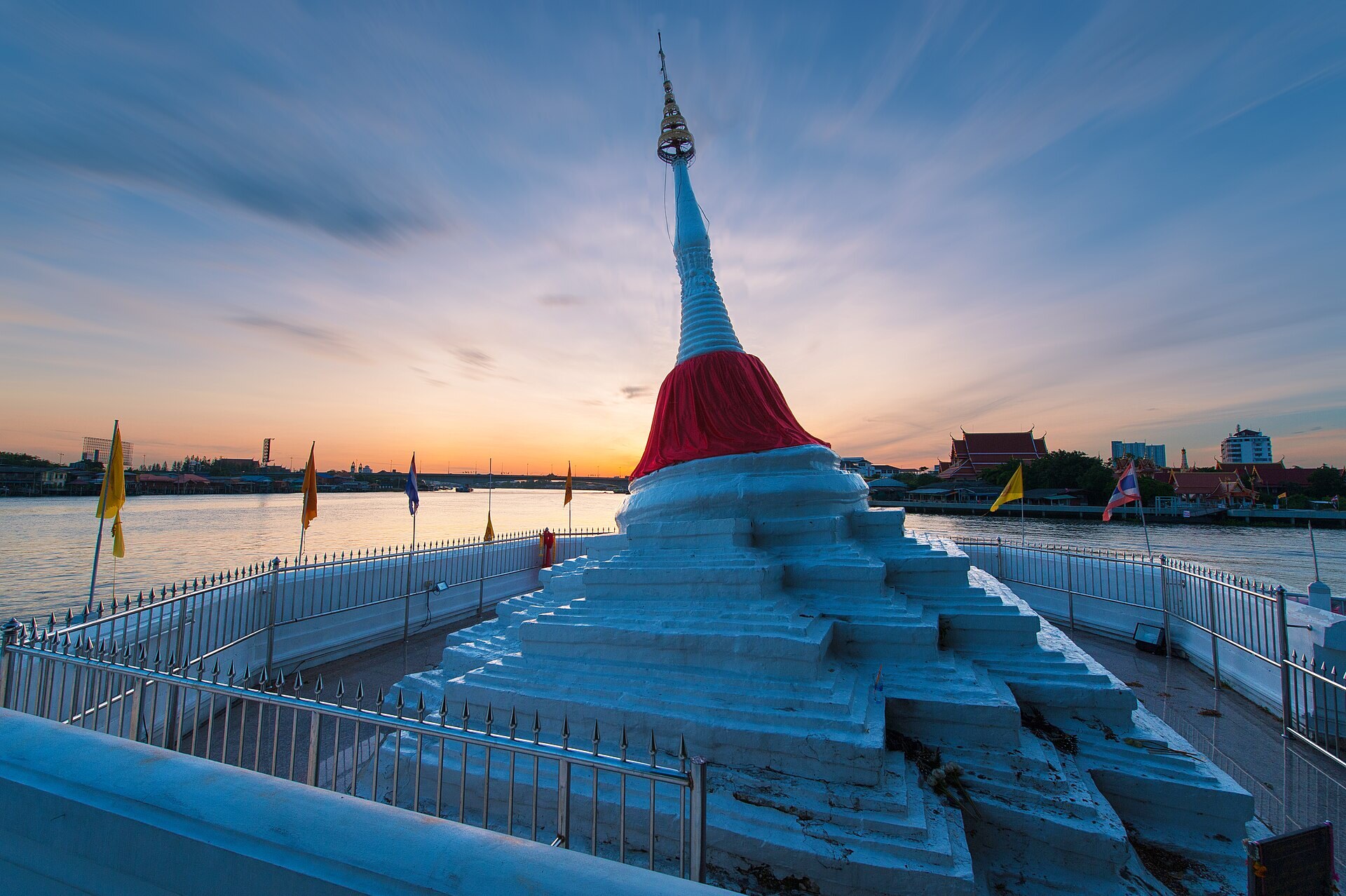
Koh Kret has no single market building. Instead, the weekend trade spreads along the concrete lanes that loop the island, thickest near the temple and the main pottery kilns, thinner as you walk toward the quieter western side. Weekday visitors sometimes arrive expecting the same density and find half the stalls shuttered. That is the honest baseline: this is a Saturday and Sunday event, roughly 9:00 to 17:00, with some vendors packing earlier if trade is slow or the weather turns. Nothing here runs on a fixed printed schedule, so treat any time mentioned as approximate and check conditions on arrival.
How the lanes are laid out
The island's path forms a loop of about 2 kilometers, walkable in 40 to 50 minutes without stopping, though nobody walks it without stopping. From the main pier, the lane splits toward the temple complex on one side and the pottery workshops on the other. Weekend stalls cluster thickest in the 300 meters nearest the pier, where foot traffic from arriving boats is highest. Past the temple, the crowd thins and the lane narrows to barely a meter in places, single file past workshop doorways. Keep right where possible; this is still a working village, not a pedestrian mall, and motorbikes and the occasional delivery cart use the same lanes.
What to eat, and in what order
Mon cooking traditions anchor the food here, distinct from the fried snacks often associated with Thai street markets. Start savory, not sweet. Many stalls sell khao chae, the cold rice-in-scented-water dish traditionally served in Thailand's hot season (roughly March to May) with a set of small savory side dishes: stuffed peppers, sweet shredded fish, shallots. Outside that season you may still find it, but check the stall before assuming it is on offer. Prices for a khao chae set typically run 60 to 120 baht depending on portion and number of sides.
Kwan aman, the Mon-style coconut dessert, appears at several stalls and is worth having after the savory dishes, not before; the sequence matters for how the flavors land. Expect 20 to 40 baht for a small portion. Between these two anchors, look for grilled items and seasonal fruit sold by weight. Portions are generally small, built for grazing rather than a single sit-down meal, which suits the walking pace of the island.
Weekend stalls are busiest between 11:00 and 14:00. Arrive by the first or second ferry crossing of the morning (crossings run every few minutes from the main pier) if you want to see stalls being set up and avoid the midday crowd near the temple.
Pottery stalls versus food stalls
The island's namesake pottery is sold both from permanent workshop fronts and from temporary weekend tables set up along the main lane. Permanent workshops tend to hold fixed prices; weekend tables sometimes negotiate, particularly for multiple pieces. Small glazed items start around 50 baht, with larger decorative pieces well into the low thousands. If a piece is heavy or fragile, ask the stall whether they wrap for boat or car transport; most do, but not all carry packing material for larger ceramics.
Getting there and the ferry rhythm
Most weekend visitors arrive via the small cross-river ferries that link Koh Kret to the Pak Kret side of the Chao Phraya, a crossing of two to three minutes for a few baht per person. These boats run frequently, often every 5 to 10 minutes during weekend daylight hours, though the exact frequency depends on demand and the boatman's own schedule. There is no single ticket booth system to rely on; pay on board or at the pier as instructed locally. If you are coming from central Bangkok, the river taxi plus a short walk or motorbike taxi to the crossing point is the common route; allow an hour or more door to door depending on where you start.
Weekday contrast, for comparison
If your schedule only allows a weekday visit, expect perhaps a third of the stalls, mostly the permanent pottery workshops and a handful of food vendors near the temple. The pace is markedly slower: fewer boats, quieter lanes, and workshop owners more willing to talk about their craft since they are not managing a weekend crowd. Some travelers prefer this version of the island precisely because it matches the river's actual pace rather than the market's compressed one. Neither version is more "authentic" than the other; they are simply different days.
Practical notes for the walk
Shade is limited along the pier-side stretch, so a hat or umbrella matters more than it first seems, particularly between March and May. Cash in small denominations is the norm; few stalls take cards, and change for large notes can be slow to find on a busy Sunday. Public toilets exist near the temple complex and the main pier area, generally for a small fee (a few baht). Plan your return crossing with a buffer of 20 to 30 minutes before you actually need to leave, since the last ferries of the evening thin out and queues can form during peak weekend hours.