Koh Kret is a river island about 20 minutes by boat from Nonthaburi pier, and it exists because of a canal, not a fault of nature. In 1722, during the Ayutthaya period, a shortcut canal was dug across a bend of the Chao Phraya to ease boat traffic. Over time the river current favoured the new channel, the old bend silted at its neck, and the loop of land became an island. The Mon who had already been living and working this stretch of riverbank found themselves, quite suddenly, surrounded by water. That accident of hydrology is the first fact to hold onto: Koh Kret's isolation, which now reads as charm, was originally a side effect of infrastructure.
Who the Mon were, and why they came to Siam
The Mon are one of the oldest ethnic groups of mainland Southeast Asia, with kingdoms that once spanned parts of present-day Myanmar before Burmese expansion pushed waves of Mon communities eastward across several centuries. Groups of Mon refugees and migrants settled in Siamese territory from the Ayutthaya period onward, some fleeing conflict, some resettled by Siamese kings who valued their skills in boatbuilding, farming and ceramics. Several Mon communities took root along the Chao Phraya north of Bangkok, and the settlement that became Koh Kret was one of them. They were never a folklore act staged for visitors; they were farmers, boatmen and potters who built a working riverside economy that still, in modified form, supports the island today.
Clay, kilns and a trade that outlasted the kingdom
Mon potters brought a distinct unglazed, incised earthenware tradition, locally known as kwan aman, which became Koh Kret's defining craft and the reason the island carries the nickname "Pottery Island." Production here was never industrial in scale; it ran on family workshops, wood-fired kilns and techniques passed down inside households rather than written into manuals. Over the 20th century, cheaper mass-produced ceramics from elsewhere in Thailand undercut the commercial side of the trade, and many younger islanders moved toward other work. What survives today is smaller: a handful of active workshops, some now run by the third or fourth generation, open to visitors who want to see the wheel and the kiln rather than just buy a souvenir. The detail of how the clay is worked, fired and sold is covered properly in the guide to Koh Kret pottery, from wheel to kiln, which is worth reading before a visit if the craft itself is the draw.
A temple, a leaning chedi, and the shape of the island's center
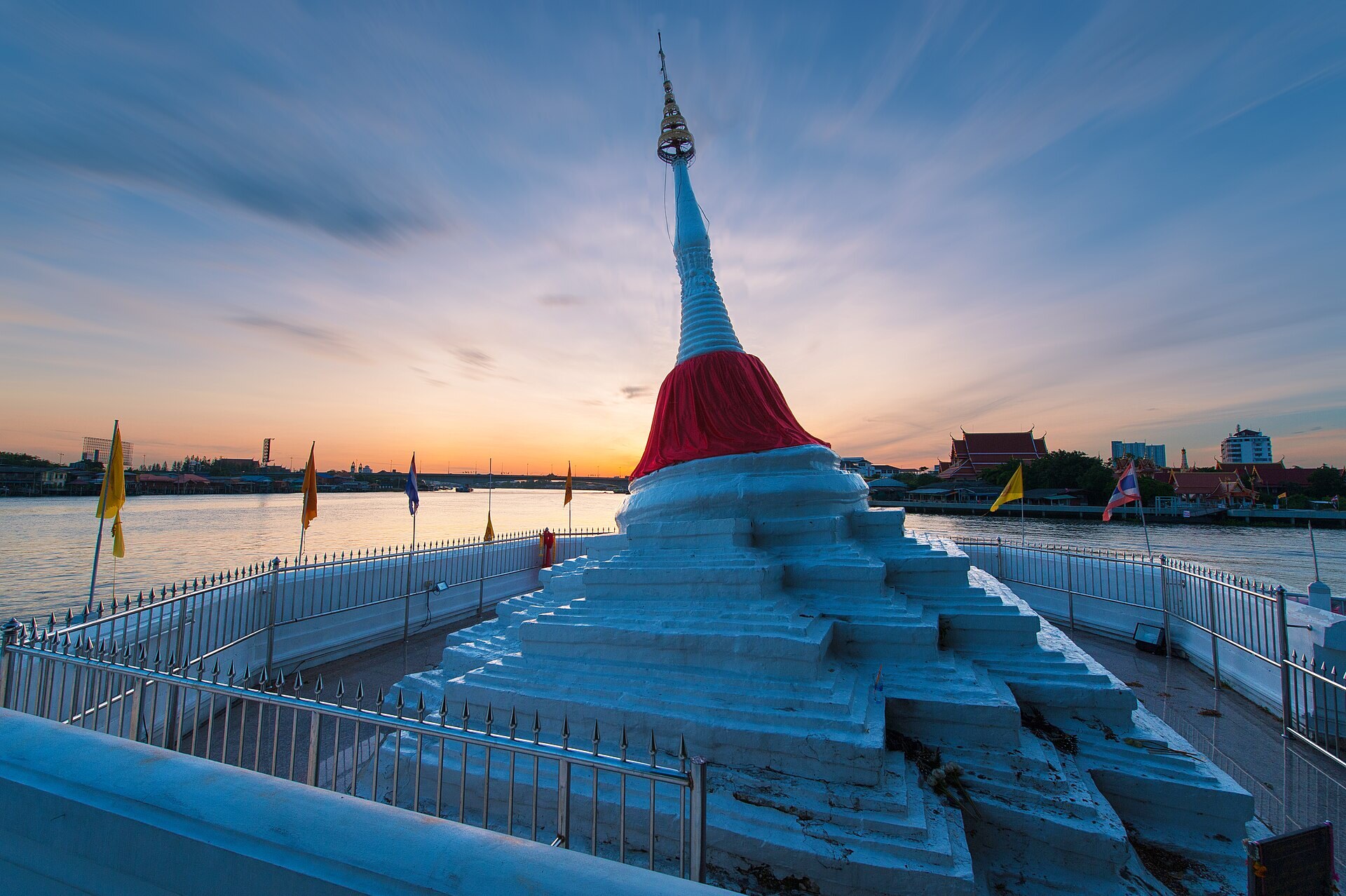
The island's religious and civic life has long centered on its main temple, home to a chedi that has leaned visibly since land along the riverbank eroded under it, decades ago. The lean is now a known landmark rather than a hazard under current access rules, and it functions as an informal compass point: most walking and cycling routes around the island radiate from this temple area. Local Mon Buddhist practice here carries small variations from mainstream central Thai practice, in language, in some merit-making customs, and in food offered during festivals, though daily temple life will look familiar to anyone who has visited other Thai temples.
Most historical sites on Koh Kret are unmarked by formal plaques. Ask at a workshop or food stall if a building's age or use is unclear; islanders generally know the story and are used to being asked, politely, outside peak weekend hours.
Why the food carries the same history as the pottery
Mon identity on Koh Kret shows up as clearly on the table as it does in the clay. Dishes such as khao chae (chilled rice served with a set of small savoury accompaniments, traditionally a hot-season dish) and certain crab-based noodle preparations trace back to Mon household cooking rather than generic central Thai menus. These are not costume dishes revived for tourists; they are versions of food that was already being cooked here before the island had boat tours. A fuller rundown of what to actually order, and where the better versions tend to be found, is in the piece on eating Mon dishes on Koh Kret.
From working village to weekend destination
Koh Kret's shift toward tourism is recent, largely a phenomenon of the last three decades, as Bangkok's growth made a half-day river escape an easy sell. Weekends now bring markedly more visitors, stalls and boat traffic than weekdays, and that gap matters more here than at most destinations: the island on a Tuesday morning and the island on a Saturday afternoon can feel like different places. Anyone weighing when to come should read the season-by-season visiting guide, since rainy-season river levels and weekday quiet both change what the history actually looks like in person, not just what it says on a sign.
What's left to see of the old island
Physical traces of the pre-tourism Mon village remain in the layout itself: narrow raised walkways instead of roads, stilted wooden houses backing onto the river, and workshops still arranged the way family production units were arranged generations ago. None of this has been reconstructed for effect; it is simply what was already there, now walked past by more people. A full loop on foot or by rented bicycle, detailed in the seven-kilometre bike loop guide, passes most of the sites mentioned here in a single unhurried circuit, usually two to three hours depending on stops. For a first visit that ties the ferry, the pottery and the food together without overplanning, the day trip overview remains the simplest starting point.